
Are Precious Metals a Good Investment? Why We Don’t Recommend Gold or Silver
 By
By

Key Takeaways
- Precious metals are rare, naturally occurring elements that hold high economic value—including gold, silver, palladium and platinum.
- Their value comes from their scarcity, beauty, and use in making high-end electronics and jewelry.
- The problem with investing in precious metals is that they offer no passive income, they’re very volatile, and they come with high costs.
- To build wealth over time, you’re better off investing in mutual funds with a long track record of strong returns.
There’s something about gold, silver and other precious metals that taps into our sense of wonder and imagination. They’re highly sought after (you’ve probably seen those folks with metal detectors combing beaches for buried treasure–or maybe you are one of those people!) and extremely valuable items to own.
Some people will go to great lengths to acquire silver coins and gold bars . . . but are they good investments?
Some investors argue that precious metals will keep you from losing money to inflation or will come in handy during an economic crisis. But once you put precious metals under the microscope, you’ll find that all that glitters isn’t (wait for it) . . . gold.
So before you decide to invest all your money in precious metals based on that late-night infomercial you saw last night, let’s get the facts straight.
Precious metals like gold and silver are commodities (meaning they’re basic goods like oil and wheat) whose prices are driven mostly by perceived supply, demand and investor fear—not by business growth. Sure, their price might rise when investors panic and drive up demand. But over the long term, they historically underperform growth stock mutual funds, and they don’t produce passive income.
Precious Metals vs. Stock Market
|
Feature |
Precious Metals (Gold, Silver, etc.) |
Growth Stock Mutual Funds |
|
Long-term average return |
10–12% historically3 |
|
|
Passive income |
None |
Dividends and business growth |
|
Price drivers |
Fear, inflation concerns, speculation |
Company earnings and economic growth |
|
Volatility |
Sharp swings during crises |
Volatile in the short term, steady in the long term |
|
Taxes |
Often taxed as collectibles (up to 28%) |
Often taxed at long-term capital gains rate (up to 20%) |
|
Wealth-building potential |
Limited long-term growth |
Strong long-term growth |
What Are Precious Metals?
Precious metals are rare, naturally occurring elements that hold high economic value. Think of them as the celebrities of the periodic table!
Unlike common metals that are used to build skyscrapers (like iron) or keep your food fresh for longer (like aluminum), their value comes from their scarcity, their beauty and their use in high-end electronics and jewelry.
Let’s dive into the “big four” in the world of precious metals: gold, silver, palladium and platinum.
Gold
The world has been obsessed with gold for thousands of years, so it’s easy to get caught up in the adventure and mystery of it—like panning for gold during the gold rush, pirate ships and treasure maps. No wonder so many people assume gold is the most valuable thing they could own.
When people “buy” gold today, they’re not purchasing gold bars from pawn shops and burying them in their backyard. Instead, they’re buying gold directly through an exchange, or they’re buying mutual funds that invest in gold. Their goal is to diversify their investment portfolio or safeguard against inflation. But is investing in gold a good way to do that? Nope. Sorry to burst your 24-karat bubble, but gold isn’t worth what you think it is.
When you decide to invest in gold thinking you’re going to be “one of the smart ones” if the dollar tanks or prices skyrocket, you actually may have just flushed your money down the toilet. Why? Because historically, gold doesn’t do a great job of keeping up with inflation.
Listen, when it comes to long-term investing, you’re looking for investments that will outpace inflation over the long haul—and good growth stock mutual funds are the best way to do that (we’ll explain why in a minute).
Silver
When you think of silver, you may picture your grandma’s silverware or your favorite necklace. But you probably don’t think of its use in mirrors, dental fillings, batteries or even those touch screen gloves you got for Christmas.4
Some people believe silver is a better investment than gold. They hope its lower price point will get them a better return if the markets ever change for the better. But here’s the truth: Silver prices (just like gold prices) are driven by fear and greed—not by any real value in the metal itself. The only use for silver (or gold) in an economic crisis would be to hope someone would take your silver coins in exchange for a pack of toilet paper or a can of gas.
Palladium
While palladium sounds like the name for a high-end concert hall or a mysterious substance in a sci-fi movie, the reality isn’t as exciting. In fact, you’re more likely to find this silvery-white metal under your car than in a treasure chest!
Palladium is primarily used in cars to make toxic exhaust fumes less harmful. It’s also sometimes used in electronics, dental fillings and that white gold wedding band on your finger (which is often just yellow gold mixed with palladium).5
Some investors like investing in palladium because it’s much rarer than gold or silver. They’re betting that as long as people drive gasoline-powered cars, the demand for palladium will stay high, potentially leading to a massive payday if the supply gets tight.
It feels like a smart play—but palladium is a one-trick pony, and it could be a costly one. Since its value is so closely tied to the auto industry, a single shift in technology (like the rise of electric vehicles that don’t release harmful fumes) could send the price into a tailspin. As a result, palladium often sees price swings that would make the most seasoned day trader’s head spin.
Platinum
Platinum is most commonly used in jewelry. But it may surprise you to know that it’s also used to make dental fillings, pacemakers and car parts like converters and spark plugs. Not only that, it’s often used in chemotherapy.6
Not to sound like a broken record here, but just like gold, silver and palladium, platinum isn’t the investment you’re looking for because it does a poor job keeping up with inflation and is extremely volatile and unreliable as a long-term investment. If you want to be a fancy investor and expand your portfolio, look elsewhere.
Here's A Tip
Because of their highly volatile price swings and lack of passive income, commodities like precious metals aren’t going to save you from inflation.
How to Invest in Precious Metals
There are two main ways to invest in precious metals:
- Buy the physical gold, silver, palladium or platinum outright.
- Buy an exchange-traded fund (ETF) or a mutual fund with precious metals in the mix.
When you buy the precious metal outright, you might feel like you’ve struck gold (literally). Just like when you hold a dollar bill in your hand, you have the security of physically seeing those gold bars or silver coins and holding them in your hand (or stuffing them in your safety deposit box).
With ETFs, you buy stock in the precious metal of your choice. That stock is tied to the current value of the gold, silver, palladium, or platinum you invested in. So buying a gold ETF doesn’t mean you own physical gold bars—it means you own ETF shares tied to the price of gold.
What Are the Biggest Myths About Investing in Precious Metals?
We’re going to be up-front with you: We never recommend investing in precious metals. It’s simply not part of the winning strategy that’s helped millions of Americans build wealth and become Baby Steps Millionaires.
But you don’t have to look hard to find a lot of advice that says investing in precious metals is the best idea ever. The thing is, that advice is built on some powerful myths, so let’s talk about them.
Myth #1: They provide a hedge against inflation.
When the cost of living rises and the U.S. dollar loses value, precious metals—especially gold—usually maintain their value in the short-term. In early 2026, gold reached record highs as investors looked for protection against nagging inflation fears that just wouldn’t seem to go away.
But in the weeks following, the price of commodities like gold and silver rose and fell based on wherever the economic and geopolitical winds appeared to be blowing on any given day.7 That’s no way to build long-term wealth.
Here’s a better solution: Invest in growth stock mutual funds that have a better chance of providing investment growth that will outpace inflation. Historically, the average annual rate of return of the S&P 500, which is used to measure the overall performance of the stock market, is between 10–12% per year (inflation historically averages 3–4% annually).8
“Commodities are always going up and down, up and down. It’s got a poor rate of return, and there’s nothing that drives the price except for people’s fear or greed.” — Dave Ramsey
Myth #2: They are a safe haven in times of crisis.
Whether it was the 2008 financial crisis or the 2020 crash caused by the COVID-19 outbreak, gold was looked at as a critical "buffer" for investors whose stock portfolios were plummeting. When people are afraid the economy might crash, they run to invest in gold, believing they’ll be safe financially. But that’s another myth.
In reality, precious metals are like any other commodity on the market—like a bushel of wheat, a barrel of oil or (in more recent times) toilet paper and hand sanitizer. As investors run to invest in gold during an economic crisis, they create what’s called a perceived scarcity—which makes people think that the supply of gold is limited or running out (regardless of whether that’s true).
That perceived scarcity triggers widespread fear and panic that drives demand through the roof, and higher demand drives up prices. But the higher prices aren’t based on any real value in the precious metals themselves—they’re being driven by emotions like fear or greed. And the rush won’t last long term.
Myth #3: They provide diversification for your portfolio.
In the world of investing, diversification means not putting all your eggs in one basket. For some investors, adding precious metals to their portfolio is just another way to add a different type of egg to their basket of investments.
But when you invest in precious metals, get ready to spend a lot of time agonizing over the rise and fall of their value in the short term—just for underwhelming growth in the long term. That’s not a plan for success.
If you want diversification, you’re better off investing in mutual funds through your 401(k)—particularly in good growth stock mutual funds that are invested in stocks of dozens (or even hundreds) of different companies. You could also invest in paid-for real estate properties that are likely to increase in value and provide a steady income stream.
Don’t let fear drive your investment decisions. If you want to learn more about how to safely and efficiently diversify your portfolio, you should schedule some time to meet with a financial advisor.
Why You Shouldn’t Invest in Precious Metals
Unless you want to get into the jewelry-making game, investing your hard-earned dollars into precious metals like gold, silver, palladium and platinum is not the best use of your money. Here’s why.
1. They offer no passive income.
When you buy shares of a mutual fund, you’re investing in companies that are working to create products, innovate and generate profits. These companies will often reinvest those profits to grow the business further, which in turn leads to the growth of your investment.
But precious metals just . . . sit there. They don’t produce anything, they don’t pay dividends, and they don’t earn interest. If you put an ounce of gold in a drawer for 50 years, you’ll still only have an ounce of gold when you take it out—and it’s only worth what someone is willing to pay for it.
Because precious metals don’t produce cash flow, the only way to make money is to sell for more than you paid for them. During a “bull market” (where the stock market is performing well and most stocks are returning 10–15% annually on average), having gold in your portfolio can feel like holding on to a bunch of dead weight.
2. They’re extremely volatile.
Platinum and palladium are much more volatile than gold, but all precious metals tend to violently swing upward or downward based on what’s happening in the world.
Sure, some precious metals might see their prices soar when investors flee the stock market like it’s on fire. But even when the markets go haywire, their prices still might crash when there’s a recession. That’s because industrial production slows down during recessions, and many of these precious metals are used heavily in manufacturing and production.
3. They come with higher costs and higher taxes.
The IRS treats precious metals as “collectibles” instead of “securities” (like most other traditional investments). This means if you hold them for over a year and sell for a profit in a standard brokerage account, you may be taxed at a maximum rate of 28%, depending on your tax bracket. That’s a much higher rate than the standard long-term capital gains tax rate for stocks (which is up to 20%).
On top of that, physical precious metals often come with additional costs like dealer premiums (a markup to cover the dealer’s profit, minting and shipping), storage fees and insurance (to protect your investment against theft or damage from a natural disaster).
“I don’t buy precious metals at all because I like my money—I don’t want to lose it. That simple.” — Dave Ramsey
A Better Way to Invest for Your Future
When it comes to saving for your retirement future, keep these five core investing principles top of mind:
- Get out of debt and have an emergency fund in place first.
- Invest 15% of your income in tax-advantaged retirement accounts.
- Invest in good growth stock mutual funds.
- Keep a long-term perspective and invest consistently.
- Work with a financial advisor.
It’s really that simple! But let’s focus on growth stock mutual funds for a minute, because they are the investment option Ramsey Solutions recommends the most.
Mutual funds provide stronger returns than precious metals over time, and you can diversify your portfolio with the right mix of funds. Mutual funds can lower your investment risk while allowing you to still benefit from the stock market’s growth potential.
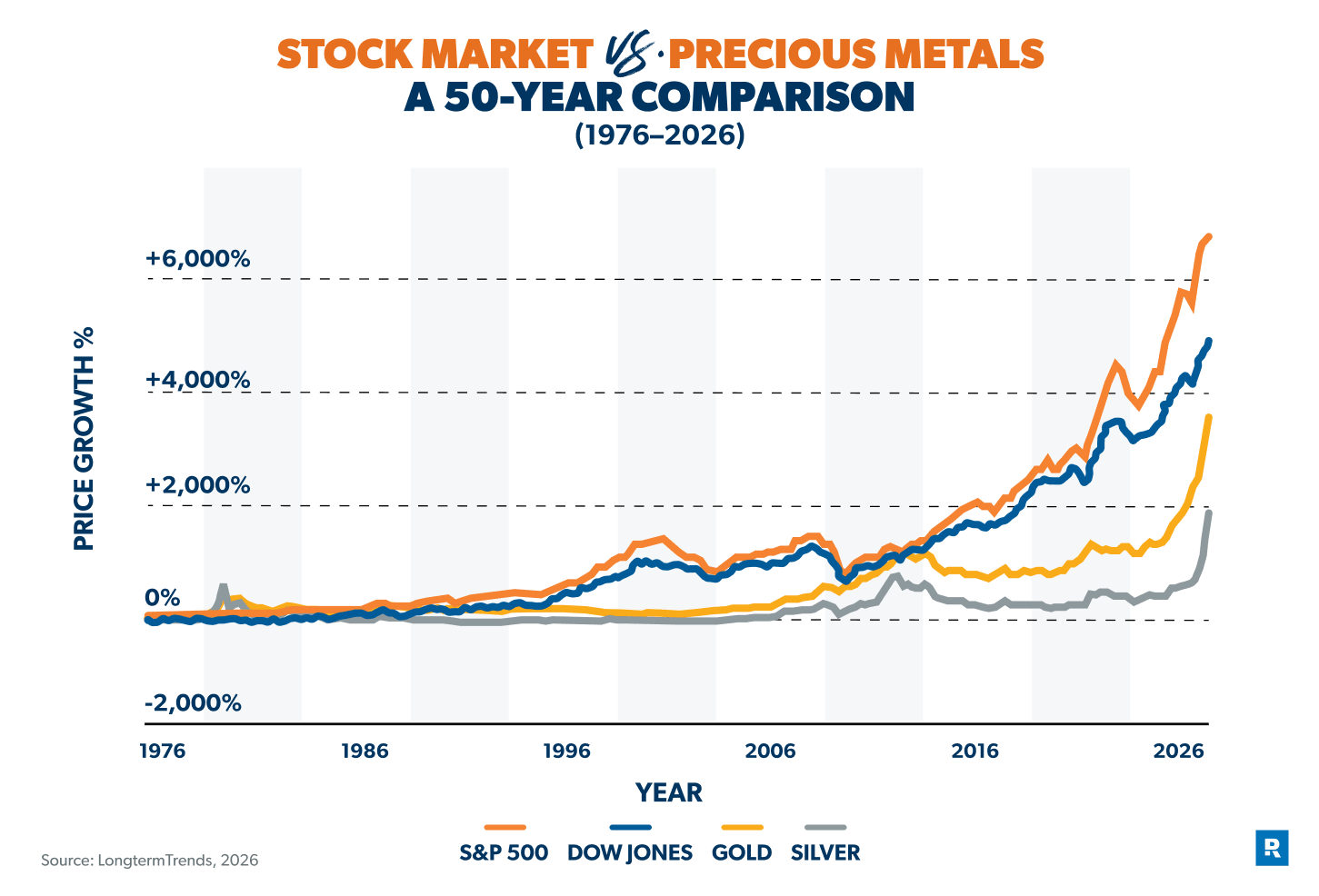
To really understand why mutual funds are a better long-term investment than precious metals, just look at how much better stocks have performed over gold and silver over the past 50 years.
Stock Market vs. Precious Metals Over 50 Years (1976–2026)
|
Investment |
Average Annual Rate of Return |
Value of Initial $10,000 Investment |
|
S&P 5009 |
13.17% |
$4,859,211 |
|
Dow Jones10 |
9.91% |
$1,126,835 |
|
Gold11 |
9.38% |
$884,904 |
|
Silver12 |
7.76% |
$419,642 |
In times of uncertainty, people run to gold out of the false assumption that it’s a safe investment or could be useful in a complete economic collapse.
But if the economy collapses, you probably won’t be able to take a bag of gold coins to the gas station and exchange it for a tank of gas. In that scenario, people would go back to the bartering system, where people exchange goods and services between each other based on mutual value. And like Dave Ramsey says, “At no time has gold been used as a medium of exchange in a crashed economy since the Roman Empire.”
The price of gold and other precious metals is almost totally dependent on fear and greed—and when people make decisions based on fear (or greed), they make poor investment decisions. You’re not thinking straight when you’re scared!
But investing in mutual funds through 401(k)s and IRAs puts you in good company. You’re following a proven plan that’s helped millions of Americans become Baby Steps Millionaires slowly over time.
Next Steps
- Learn more about Ramsey Solutions’ investing philosophy, which has helped millions of Americans build wealth and secure their retirement futures.
- Diversify your investment portfolio by spreading your money between investments. This will help you lower your investment risk and take advantage of compound growth.
- Get in touch with an investment professional who can help you create a game plan for your investments. SmartVestor can help you get connected with one.
Frequently Asked Questions
-
Is gold a safe investment?
-
No, gold is not a safe investment. Here’s why. First, gold doesn’t perform as well over the long-term when compared to other investments—especially good growth stock mutual funds. Second, it doesn’t actually produce any income. The only way you make money investing in gold is by hoping someone is willing to pay more for it than you did—and as much as we like hope, it’s just not a very good investing strategy.
Here’s the bottom line: Don’t let fear and greed drive your investment decisions. Instead, stick with proven, long-term investments that have a track record of building wealth—not shiny objects that go up and down based on emotion.
-
Is gold a hedge against inflation?
-
Contrary to popular belief, gold isn’t really a good hedge against inflation. That’s because the price of gold doesn’t actually follow inflation all the time. In other words, if inflation starts ticking up at a higher-than-normal rate, it’s not a slam-dunk guarantee that gold prices will rise in response.
The price of gold is driven by fear and greed. When people panic about the economy or inflation, they rush to buy gold thinking it’ll protect them. But historically, that just doesn’t play out.
The average inflation rate has been around 3–4% per year. If you invest in good growth stock mutual funds, you’re looking at average returns of 10–12% over the long haul, which is way better than gold.1
-
Is silver a better investment than gold?
-
Nope, silver is not a better investment than gold. Some people think silver’s lower price point makes it a smarter play. The thinking goes that since they paid less to get more with silver, they’ll get better value and higher returns if the market shifts in their favor. But silver is just as unstable and unreliable as gold—and, yes, silver has still performed worse than gold, historically.
-
Should I put gold in my retirement portfolio?
-
No, do not put gold in your retirement portfolio. Historically, it’s a bad investment because it has a poor rate of return compared to other investments like stocks and real estate. Also, its price is very volatile, which means one month gold might soar to historic highs before falling dramatically in value the next month. You don’t need that kind of drama in your nest egg!
Your best bet for retirement is to invest 15% of your gross income into tax-advantaged retirement accounts (like your 401(k) and Roth IRA). That money should be spread across four types of growth stock mutual funds (growth and income, growth, aggressive growth, and international). That way, you’ll have a diversified retirement portfolio that lowers your investment risk while still getting the benefits of stock market growth. Win-win!
This article provides general guidelines about investing topics. Your situation may be unique. To discuss a plan for your situation, connect with a SmartVestor Pro. Ramsey Solutions is a paid, non-client promoter of participating Pros.
Get Weekly Insights Delivered Straight to Your Inbox
Did you find this article helpful? Share it!

About the author
Ramsey Solutions

Get proven Ramsey answers fast.
